
Enterprise Security AI Agent Architecture
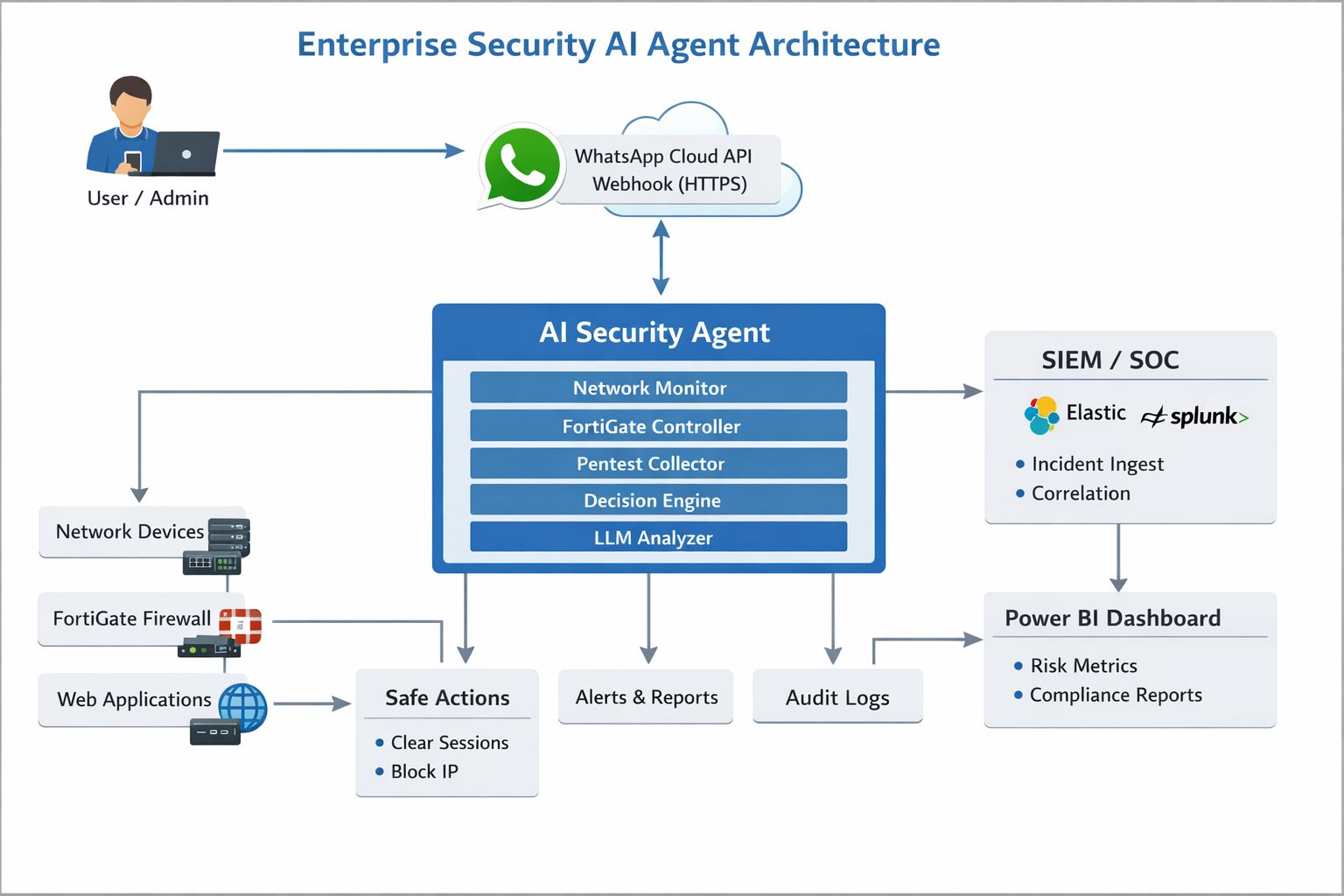
This diagram illustrates a practical blueprint for building an Enterprise Security AI Agent that connects infrastructure operations with security monitoring and automated response. The goal is to reduce detection and response time by turning raw security signals into prioritized, actionable outcomes—while keeping full visibility for auditing and reporting.
At the edge of the environment, network devices (switches/routers), the FortiGate firewall, and web applications generate events such as authentication logs, traffic anomalies, policy hits, blocked connections, and suspicious behavior. These signals are collected continuously and passed into the AI Security Agent for normalization and decision-making.
Initial Setup (From Zero to First Working Version)
In the first phase, the environment is prepared to produce reliable telemetry. This typically includes enabling and validating:
- Syslog from network devices and FortiGate
- Windows/Linux logs (where applicable)
- Time synchronization (NTP) to ensure accurate timestamps
- A clear naming and tagging strategy (sites, VLANs, devices, roles)
Next, a SIEM platform (such as Elastic or Splunk) is configured for ingestion. Indexes/data streams are created, parsing rules are verified, and dashboards are built to confirm that events are arriving correctly. This step is critical: if the pipeline is not clean, automation will become noisy and unreliable.
AI Security Agent Role (Orchestration Layer)
At the center, the AI Security Agent works as an orchestration and intelligence layer. It includes functions such as:
- Network Monitor: watches traffic patterns, device health, and baselines
- FortiGate Controller: reads policy hits, UTM events, VPN logs, and can trigger controlled actions
- Pentest / Security Collector: collects relevant signals, indicators, and security observations
- Decision Engine: prioritizes events, reduces noise, and determines the best response path
- LLM Analyzer: produces human-readable incident summaries, classifications, and investigation guidance
Instead of reacting to every alert, the agent focuses on correlation, context, and impact—so the team sees fewer false positives and more meaningful incidents.
SIEM/SOC Integration (Correlation & Incident Handling)
After processing, the agent sends structured events to the SIEM/SOC layer for:
- Incident ingest (central collection and storage)
- Correlation (linking multiple signals into one incident)
- Investigation workflows (queries, timelines, enrichment)
This design allows the SOC or IT team to track incidents end-to-end and measure improvements over time (mean time to detect/respond, recurring sources, top attack vectors).
Automated Actions with Safe Guardrails
A key part of the architecture is “Safe Actions.” These are controlled, low-risk responses that can be automated or semi-automated, such as:
- Blocking malicious IPs/domains (policy updates or address objects)
- Clearing sessions or terminating suspicious connections
- Triggering alerts and creating structured reports
- Writing audit logs for every action taken
The design encourages a phased rollout: start with recommendations only, then move to approval-based actions, and finally allow fully automated actions for well-tested, low-risk scenarios.
Reporting & Visibility (Dashboards and Metrics)
Finally, the output is made visible through reporting tools such as Power BI dashboards or SIEM dashboards. These provide:
- Risk metrics and security posture trends
- Compliance-ready reporting
- Service health visibility across infrastructure and security layers
This ensures leadership and technical teams can see measurable outcomes—not just raw logs.
Summary
Overall, this architecture demonstrates how a security AI agent can combine telemetry collection, SIEM correlation, human-friendly analysis, and controlled automation to improve operational reliability and security. It’s designed to scale across multi-site environments and to support both daily troubleshooting and incident response in a consistent, auditable way.